Crit Lit

Mountains and snow - they go together like books and critics.
Writers love feedback. It's like getting free samples on a visit to a sweet factory - first and foremost we're glad to be there at all and then there are extra goodies. What's not to like? Funny you should ask that! 

Does anyone remember acid drops? The sweets, not the psychedelic experience! Sweet and sharp, and surprisingly moreish (and yes, that does look a strange word). Is anyone else thinking: book reviews? We feverishly check Amazon and Goodreads, and are often drawn to the negative reviews more than the positive ones. I'd like to think we're looking for valuable pointers, in order to improve for our next book, but maybe it's simply hard to fathom why readers didn't appreciate the sweeping emotional landscape and the troubled yet finely drawn characters. Or, to quote a book review I received recently, they might just think your protagonist was way too sissified. 

Now, I'm fortunate in having a psychological quirk that means 'bad news' is often amusing to me. My own, I mean. So while I genuinely appreciate the fact that anyone thinks enough about one of my books to take the time and trouble to write a review, I'm also amused when I know I'm reading something that will make my ego bristle a little.

Goodreads has a sage view of the whole business.


As I often say, context is everything. One person loathing your heroine or hero is one thing; 20 people loathing her / him for the same reason is more of a cause for concern. Well, unless your character is called Mr Ripley or Hannibal and that's your intention.

So, by way of entertainment - for both of us - I thought I'd share some of the feedback I received about Standpoint before it was published. These are from agents, publishers and a reader. Enjoy, as I do!


OK: I liked your new spin on the thriller genre, with a hero who is a civil servant, but I found the plot a little too convoluted and far-fetched at times.

We felt that your novel was an old take in a genre that has been stale for a long time.

I've agonised over this. As the various reports that you've taken the trouble to commission say you write very well. My one reservation is that the book doesn't sufficiently stand out in what is a very crowded market. An agent with more experience of the current fiction market is a better bet for you but I'm sure you'll find a publisher and I'd love to know what happens.

We found the concept intriguing!  In a thriller, we're looking for mystery, intense action and vivid descriptions to really show us what's going on and make us unable to stop turning pages right from the opening.

I found Standpoint to be a little too 'laddish' for my tastes.

Just finished your book tonight. Really enjoyed it and thought the story was excellent. I don't do much reading but for what its worth I thought this was really good. I found it easy to read and follow which is a good sign it’s accessible to the masses. Thanks for the read.

The idea of a thriller based around a government special surveillance unit is quite interesting and the writing is competent but the characters do not stand out, excite or intrigue enough I am afraid.

While we enjoyed reading your submission, which stood out from the many we receive, we couldn't find an agent here who felt strongly enough to take it further and therefore we are afraid we are not able to offer you representation for this project.

We like the beginning very much, the writing is good with a humorous tone. But for a thriller it feels too little thriller-ish, and we feel it’s too long, so I’m afraid we’ll give it a pass.

What's the context I talked about? Early indications are that Standpoint has sold over 5000 copies since it launched at the tail end of March.  My point being that one critical swallow needn't ruin your summer. And if the book you write is, according to popular opinion, a bit of a stinker...write a better one.

Perhaps...you're a writer?


Perhaps...you're a writer?

With all due respects to Mr Kipling's exceedingly good prose.


If you can keep your word count when all about you   
Are losing theirs and blaming it on 'responsibilities',   
If you can trust your plot when your inner critic doubts you,
But make allowance for some valid observations too;   
If you can wait for months and not be tired by submissions,
Or being ignored, don’t deal in ignorance,
Or being bad mouthed, don’t give way to badmouthing,
And yet don’t look too pleased with yourself, or use the terms LOL and LMAO;

If you can dream—and not make dreams an excuse for not adding pages;   
If you can think—and not use cliches for the umpteenth time;   
If you can meet with a request for a full or an outright rejection
And treat those two impostors just the same;   
If you can bear to read the words you’ve written
Twisted by knaves to make a trap for fools in online reviews,
Or watch the stories you gave your heart to, trampled on,
And stoop and build ’em up with worn-out pens:

If you can make one heap of all your scribblings
And risk another full edit,
And fail, and start again from that chapter everyone liked
And never breathe a word about your pain, except on your blog, and Twitter and Facebook;
If you can force your brain and soul and fingers
To add to a first draft long after you've fallen out of love with the concept,   
And so hold on when there is no evidence it will work
Except the vague notion that there's a good book in there somewhere;

If you can talk with beginners and keep your humility and sense of humour,   
Or, meeting agents and publishers, not come across as desperate or arrogant (or weird),
If neither deadlines nor interruptions can hurt you,
If loved ones and friends count with you, but none too much, at times, when compared with the lives of your fictional friends;
If you can fill the uninspiring minute
With sixty seconds’ writing without fear,   
Yours is the text and everything that’s in it,   
And—which is more—you’ll be a Writer, my dear!

A Numbers Game


Safety in numbers?

I love the poetry of numbers, and the certainty. Two minuses added together (or multiplied) result in a positive number. Prime numbers conform to agreed rules - although I have read fierce debates over the inclusion of 1 and 2. And that 'adding up to 9' rule is very handy when it comes to Countdown. If there is a language of the Gods it's probably mathematics.

The only Freddie the Fly in the ointment is that the world of numbers can also be random. Algorithm generation, statistics and data analysis (weather forecasts, anyone?) - to name but three examples - serve to remind us that the dependability of mathematics doesn't always translate to predictability in daily life.

My fascination with numbers found new ground after my debut thriller, Standpoint, was published by Joffe Books. Because it was an ebook (now also available as a paperback on Amazon - just sayin'), with a low price point, business has apparently been swift at times. It's human nature to want to see or impose order on the chaos of the world, especially when there's something important at stake. Consequently, there is a tendency to see situations as static rather than fluid. 

I watched with gratitude as, once a special offer free period had expired, the rankings (and therefore the sales.) improved significantly. Before then, my book climbed the rankings of the Free on Kindle league table, amassing over 20,000 free downloads. Once the book reverted to its original price sales flourished. In a relatively short period of time Standpoint was No 1 in all three of its categories: International Mystery & Crime, Espionage, and Spy Stories. 

It didn't last forever though, partly because it's hard to maintain that level of new readers and partly because the mysterious metrics and measures Kindle uses (believe me, I have tried to find something useful to share with you on that score) also compares your sales against those of other books in the same category/ies. You can still be doing well, only others are doing better.

Then there are the reviews. Ideally, a healthy percentage of those 20,000 downloads will result in Amazon reviews. However, not everyone who downloads a book reads it straight away. Also, not everyone who downloads and reads an ebook feels strongly enough about it to leave a comment. The negative reviews may or may not be useful to you. (I maintain that if they have cogent points then they're still useful, even if you vehemently disagree with them.) Still, relevant and accurate or not, each review contributes to your average score, which is all some people need to decide if they're going to become a reader of your work. Positive reviews are no less tricky. Some people prefer not to give anything five stars, while comments such as 'nice' tell the would-be reader nothing at all and may even infer that the reviewer couldn't find anything more positive to say about the book.

When it comes to social media, numbers are all important. Every FB share or retweet or favourite is potentially a whole new community being made aware of your work. The greater the reach and the greater the diversity, the more opportunities there are to entice new readers. One friend of mine - hello, Sarah Campbell - went beyond the call and put a classified ad in an online staff magazine about my books. That's what I call brand loyalty!

Zen and the art of social media

1. What is the sound of one tweet repeating? 

2. If a Facebook post about a new book is only read by one person, in a forest, does it make a sound? (Certainly not a splash.)


Is it possible to beat the house and play the game when it comes to book promotion?

My experience suggests that certain things can give you a competitive advantage in the short term. One thing you can't predict is context. Write a novel about orangutans and you might get some airplay based on the novelty (no pun intended, this time) of the subject. But if the book is launched at the same time that a tabloid runs a front page story about Oscar the orangutan, and his uncanny ability to play Chopin on the piano, the odds are in your favour.

Perhaps, in the end, the writer's certainty lies not in numbers but in words. The better we write, and the better we edit, the greater the likelihood that an agent or publisher will take an interest. Or, that our feedback will give us the confidence to take the plunge and self-publish.

Yes, there are thousands, possibly millions of writers out there, ready to ply their trade. In the end though, you're only interested in one.


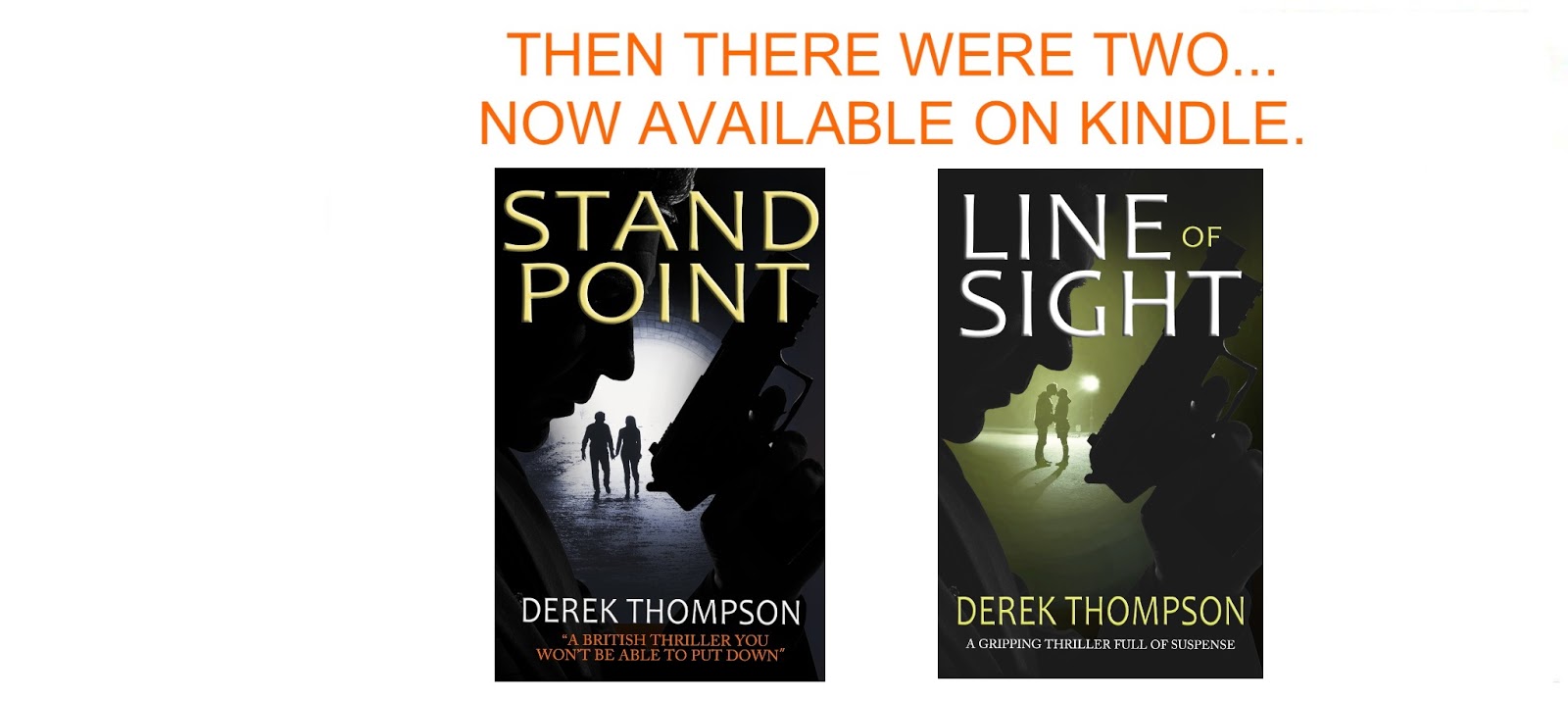
Standpoint


Line of Sight


From there to here - where my thriller came from.


It fits together nicely.
A little while ago, a friend of mine - also a thriller writer - asked me an unexpected question. We were chatting about writing and life and the universe, as you do, when he paused and said, "How did you manage it? How did you write your book and finally get it out there?"

I understood what he meant. He'd also been present at the 2008 Falmouth Uni novel writing summer school where Standpoint was born, one fledgling novel among the many. I don't know how the other writers have made out, apart from one who was published and another who secured a literary agent. 

To answer how I did it, I'd need to do a little time-travelling, back to childhood and forward to the steps I took after Standpoint was published by Joffe Books.

Yes, this could be a tea-break length read. Best grab yourself a cuppa, a comfy chair and the biscuits of your choice.

Let's roll back the years...

Unsurprisingly, I was a bookish child. I was able to read before I started school and loved language. I learned big words and clever synonyms and obscure words, none of which were a ticket to popularity! Words could haunt me, even book titles. Two books I have remembered only by name from school are Firelight and Candlelight and Moonshine and Magic. If anyone can tell me the contents please drop me a line. One event stands out for me - an inconsequential game of hide and seek on a housing estate. It was our side's turn to hide and I found a great vantage point to watch the other team. One by one our side were captured until I was the only one left. I could have given up and ended the game, but I wanted to watch and see what they did. It seemed like forever before they all went their separate ways. 

Books were also an escape. I wasn't what you'd call a very happy child, especially as a teenager. Naturally I went down the well-worn route of writing terrible (and terribly self-obsessed) poetry, and attempted my first novel at the age of 15. It was a book about a psychic and his best friend, and a government plot (spot the thread...), and I eventually burned the book. I still remember much of it and I included one of the character names in Standpoint. (It's Ann Crossley, in case you were wondering.)

After leaving school, I entered the world of employment where a wonderful man named Michael Phillips took some of my angst poetry and added music. I still have the cassette tape, but sadly I lost touch with Michael when I left that job. If I could travel back in time I'd thank him for helping to keep a flame alive. I went from poetry to song lyrics (progressed would be too strong a word), and formed a band with two friends. We rehearsed one song - called Coffin Nails - but the band disbanded before we played a single gig (or a second rehearsal). I have a cassette tape of our one practice session as well and we were bloody awful. I named the band Bad Timing, so the clues were there.

Around that time I was getting interested in politics - animal rights, local activism, protests. All  from the sidelines of course! I joined a couple of writers' groups and felt a mixture of awe and inadequacy. Around that time I started what eventually became a self-published magical fantasy, Covenant. I would be the one in the pub with friends, scribbling into a notebook. 

I went from noting life's dramas around me to having one or two of my own. I was mugged by a guy with a claw hammer and a place I worked was raided and someone stuck a pistol in my back. At 21 I took my second trip to the USA, intending to start a new life, in a new relationship, and to become a writer. Maybe that's a bit grandiose, but I wasn't planning on coming back any time soon. New York is a city filled with stories - as is London, except I saw New York through a foreigner's eyes. Fate and drama weren't done with me yet, however. A taxi I was in had a head-on collision with a van - resulting in a short spell in hospital, I had another gun incident - this time due to me, and my father died while I was away. 

Creatively, that fantasy novel progressed and I had some ideas for short stories. I didn't know it at the time but I was also squirrelling away experiences, scribblings, and other people's real life stories. I kept a series of diaries as well, each one more false than the last. It was a very long time before I could confront those lies and allow the colourful and occasionally bitter truth to seep through to a new set of pages. Scars & Stripes is my fictionalised version of those times, a transatlantic dark comedy drama. That one's still waiting for an audience.

When I returned to the UK, poorer, wiser and colder, I continued to keep writing journals. I got on with my life and - in the absence of a better plan - I kept writing. Two books had kept me company on my transatlantic adventure - Richard Bach's A Gift of Wings and Irwin Shaw's God Was Here But He Left Early. I loved the first book for the way it used flying as a stepping off point for fiction and philosophy. I loved the second book for its sophistication - tightly scripted with well-drawn characters and dramas. 

I picked away at various short story ideas of my own. In 1998 I had a short story, Behind Enemy Lines, published in an Australian Gold Coast Writers' competition. The Silent Hills was published online in 2010, and was subsequently released as a standalone short ebook by Musa Publishing in 2011. My US based short story, Diner, was published in The Coffee Shop Chronicles by A Word with You Press in 2010. My salute to Isaac Asimov, Rogue, was included in Beyond the Horizon by Bamboccioni Books in 2011. Between the Lines and other very short fiction was included in Kissing Frankenstein in 2012.

I realise, in reading this back, that I've omitted three formative events. Mum died around five years after Dad, and my brother died back in 2005. The third, minor event was my writing about David for The Guardian, back in 2008. Once I'd crossed that bridge, without it collapsing underneath me, I felt I understood what my writing is about. It doesn't have to be pretty and polite all the time. It can be raw, ugly, even untrustworthy at times. But always, I hope, there's an authenticity running through it.

That novel writing summer school I mentioned earlier revealed one of the limitations of Scars & Stripes and gave me an inescapable deadline. Those are usually the best kind - do or die. I always assumed I'd crime a detective novel, but Thomas Bladen stepped out from the shadows and introduced me to his world.

We have some things in common - preferring to be an observer, a working class upbringing, memories of the Miners' Strike, a life in London and bad experiences with guns! He worked for a time in the same civil service building as I did - State House - and we both took photos of the London skyline from one of the upper floors. (I merely took snaps on an Agfamatic 110 though.) He lives in Walthamstow while I lived just only a mile or two away. Miranda lives and works around Mile End / Bethnal Green, in London's East End - an area I used to know quite well.

Otherwise, to some extent, he is his own creation; albeit one crafted from opposites, and remembrances, and forgotten memories and untraceable inspirations.

Once I'd written Standpoint I refined it through several edits, including feedback from two writers' groups that I attended. I also commissioned an editorial report from Cornerstones (I paid for the report with some of the money I earned from my newspaper piece) and a couple of years later I did the same with TLC (thanks to a grant). Each step was vital in helping me breathe more life into the story and characters, and to cut away the deadwood.

I submitted my manuscript, of course. Boy, did I submit it. I'm almost embarrassed to review exact numbers in case my publisher reads this and wants to revisit his decision. No, sod it, let's talk numbers. 

There were 38 agents, of whom around ten never responded at all and three who gave constructive feedback. I must make special mention of Andrew Lownie, who I've mentioned elsewhere on this blog in other posts. He considered Standpoint back in 2009, but eventually turned it down and advised me to seek out an agent or a publisher who specialised in thrillers / crime fiction. He was not only very encouraging but also responded quickly and offered suggestions about who else I could try. I approached a dozen credible publishers (plus one or two shots in the dark). One kept me waiting for nine months, hanging on out of sheer bloodymindedness to see what they'd come back with. (Answer: virtually nothing.) Some of the feedback from agents and publishers was hard to hear, and some of it was funny, but that's for another blog post.

I eventually found my publisher through the now defunct www.writethismoment.com - a subscription site I used for freelance writing leads. Jasper Joffe had some reservations about how Standpoint's international appeal (which were bang on the money), and he was keen to know what my plans were for follow-up books. 

Fortunately, I was so beguiled by Thomas Bladen and his world of surveillance, by the end of Standpoint,  that I wanted to know more too. So much so that I'd already written a second book, Line of Sight, and I'd started work on a third - currently called The Caretaker. Nothing helps sell a book like knowing there's another one in the wings. My winning pitch was very much about the series and how I saw it developing. 

This blog post is my way of answering those two initial questions:
1. How did you manage it? 
2. How did you write your book and finally get it out there?

I managed it, in the end, by keeping true to my faith over the years. Not necessarily that I'd be a published novelist, although God knows that was something I dreamed of. My faith was in the power of words, since my earliest days, and their ability to evoke emotion, spark ideas, create worlds for us to escape to, and to hold us spellbound. Like a prospector, I knew in my bones that if I just kept on going I'd find treasure even if it wasn't gold.

I wrote my book line by line. Yes, I know that sounds like I'm being flippant but I mean it. Over the countless hours spent thinking, or scribbling in books, or typing, or arguing them out in my head. I found an idea that entertained and enthralled me enough to want to continue with it, even when there was no prospect of a reader on the horizon. I remembered how other authors' books had accompanied me in good times and dark times, and it spurred me on. I put writing before other things and other people - rightly or wrongly - and made the muse my mistress. 

How I got it out there was by finishing a book yet continuing to work on it, choosing agents and publishers with discernment (eventually!), and by writing in all weathers. Good times, crap times, and times when writing was both a passion and an obligation. Sometimes I just wrote (and still write) because it's what writers do. I'm past the point of questioning it now.

Persistence, learning from my mistakes, luck, timing, serendipity, an ear for dialogue, a fondness for Raymond Chandler - take your pick. So many elements go into a book, and into its success. If I wanted to be poetic I'd say that my whole life was a preparation for being a writer. But that's not the truth of it. Writing demanded honesty of me - hidden within the pages, if need be. It gave me a way of opening doors that I'd kept locked and made me more courageous, more lucid. I finally got my book out there by putting everything I'd learned along the way into practice. No magic formula, just graft!


Standpoint
Thomas Bladen is as good at finding out other people's secrets as he is at hiding his own. So what's the deal with Karl McNeill? Is he just another surveillance man, working for the unit? Or is there a darker side to Karl's life that threatens to engulf Thomas's carefully controlled world, dragging the only woman he's ever loved into the maelstrom?

Who can he trust?
How do you fight an unseen enemy?
What lies at the heart of Europe? 

amazon.co.uk

amazon.com


Line of Sight
Thomas thinks he knows the score now - who the movers and shakers are, and who's pulling the strings in the Surveillance Support Unit. But when a young woman is found dead on an army base, and only he and Karl McNeill have any hope of getting to the truth, it's time to take matters into their own hands. 

But what is Karl hiding about his own past?


If you've already bought either of my books, please leave a review.

Authority

Making waves and creating a splash.
Hello there. I'm writing this in advance, so this may only be accurate at the time of typing (on 22/04). My debut thriller, Standpoint, is doing well. I know it's not a very British thing to say,  and I'll come back to British things later, but there it is. There were 20,000 free downloads and, as I write this, there's every possibility that subsequent sales will reach into four figures soon.

It's an exciting and slightly bewildering time - a little like winning the raffle when you quite had your idea of the box of dark chocolates, and then seeing that mouthwatering box of delights heading your way. Some people are cheering for you and some want to arm-wrestle you for chocolate (who can blame them), and there's really no adequate explanation for why it has turned out that way. Maybe, sometimes, life is like a box of chocolates.

I'm acutely aware of all those people whose generosity and kindness have helped Standpoint's success, and those who aren't here to see it. It's all a learning curve and here are some of the things I've learned so far.

1. You can only write your own book, your way.
Any other option is pretty much impossible in the long run. Ghostwriting is a different kettle of fish. If you are creating something for yourself (the starting point of all books) you have to set aside what critics may think - they'll be along in time, trust me.

2. Once you've written your own book it's time to think about the reader.
I've had editors in the past and I've edited other people's work, but this is the first time I've had a complete novel edited by someone else. It's not only liberating, it's also made me look at my work differently. If something that seems obvious to you isn't obvious to your editor, you can bet your bottom dollar a reader will struggle with it too. 

3. Change is inevitable.
Beyond a word here and a semi-colon there, you may find that your cherished - and obscure - reference to 1980s' synthesiser pop doesn't translate well to a Canadian reader who wants to follow the plot not go on a Wikipedia quest. In my case I was happy to compromise on some of the minor details because they only added something for me. I also needed to think about what might add to the book.

4. Everyone's a critic and the web is their sounding board.
Feedback is an interesting thing. As writers we want the audience to engage with us and to feel something by the end of the book. However, what if their feeling is tedium? Interestingly, I've noticed a split between UK and US readers. The Brits like the relationship side of Standpoint, the tone and the character development, while some US readers struggle with the slang (now addressed by the inclusion of a glossary) and the pacing. My protagonist is not James Bond, or Jason Bourne, and I never intended him to be.

You can't please everyone and nor should you try to, but show me an author who doesn't want people to enjoy the experience of reading their book and I'll show you someone who has misunderstood the point of publication.

5. Enjoy the ride while it lasts.
Today it's all going well and I'm thrilled. Five months ago I had two and a bit novels in a series nobody wanted. Later this year my second thriller will be published by Joffe Books - spoiler: there will be slang! Sometimes things align for you and the stars are favourable. Immerse yourself in the experience and don't waste time questioning it, or looking for the formula that can replicate it. Do pay attention though!

A quote attributed to the artist, Tracey Emin, about the media, runs: "I don't ask for an apology because it's only tomorrow's fish-and-chip paper." Today's best-seller will inevitably slide down the charts and there will always be something new to surpass what once was. It's a continuum rather than a destination.

Whatever happens, going forward, I am going forward. For now, that's all I need to know.

Where do you draw the line?

In the Long Run

Who truly knows where the path leads?

Repeat clients are a freelance writers' best friend. When you build up trust and a dependable working relationship with someone it's a win-win situation. They know they can rely on you to produce the content they need, on time and on budget. You, on the other hand, are happy to prioritise their needs because they have clearly defined requirements, give relevant direction and pay their invoices promptly. It's like the end of a rom-com movie, only without the kitsch.

However, working relationships are not something you can ever afford to take for granted - pun intended. Situations change, editors move on and all businesses are subject, to a greater or lesser degree, to market forces. As a wise project manager once told me: always have a Plan B.

Your freelance what-if strategy needs to take into account the following questions:
1.     What if the client decides they want something different?
2.     What if I could increase the rate?
3.     What if there were other ideas I could pitch to them?

Not so long ago I faced all three questions with the same client. It started when I reviewed my rates and realised that I'd written over 20,000 words for the same editor. I approached the editor carefully, by which I mean I was succinct and that I led with the benefits of continuing our business arrangement. The editor agreed to a percentage increase so quickly that I could have kicked myself for not doing it sooner.

However, having reviewed my contributions, the editor also decided that it was time to retire one of my magazine columns. Foul play? Not at all. She went on to explain that most monthly columns do not extend beyond two years - like mine had - and that she would continue to need occasional top-up pieces.

More encouragingly, she was now keen to hear if I had any other column proposals (which I did, naturally), so now there's a potential opportunity to research and write about a completely different topic. I also have around 17,000 words of content that I can repurpose or offer as second rights material.

If you remember nothing else:
1.     Know your own worth, which lies somewhere between what you think you're worth and what your client thinks your work is worth to them.
2.     Don't rest on your laurels. Change is inevitable. Be prepared and be ready to take advantage of new opportunities (and the gaps left by old ones coming to an end).
3.     Push yourself in your writing. My 17,000 words and 30 columns began with a piece about our chickens and grew to encompass composting, recycling, foraging, water management, gardening, grow-your-own, herbs, making a mini-meadow, and much more besides.
4.     Be professional. Anyone who reads this blog will know that over the years I've made some clangers worthy of a campanology for beginners workshop. Even so, if freelancing is your business and your livelihood you need to take a mature, long-term view. Today's stupid client could be tomorrow's work reference!

Take heed. In the long run, you'll thank me for it.

Standpoint - Glossary of British Slang Terms


It's always struck me as slightly strange that we refer to this language as English when it's really an amalgamation of many languages that have changed and enriched it over the centuries. Back in the day (the late 80s, in case you were wondering) I spent a year in the US and soon realised that their English and my English were merely cousins. I realized it with a z for one thing, and that z was a zee for another.

A recent Amazon review for Standpoint reminded me how important it is to have common reference points, as well as a common language, when communicating. With that in mind, here's a glossary of British slang terms in Standpoint for American readers that will appear with the book from now on.

British slang: US equivalent

’andouts: handouts/charity
’scuse: excuse
4 X 4: four wheel drive vehicle/off-roader
arse: ass
bitter (type of drink): ale
blighty: informal/nostalgic term for England / the UK
bollocking: a severe reprimand
bollocks: nonsense (noun)/damn (exclamation)
booze cruise: ferry trip to bring back cheap alcohol
cheers: when not used as a toast can mean thank you
chuffed: pleased/delighted
civil servant: government worker
clogging: filling/blocking
Cockney Sparra: Cockney Sparrow - native Londoner
comprendez: do you understand [French]
craic: an enjoyable time [Irish]
Diwali: Hindu religious festival of lights
dogsbody: servant or underling
downed: drank
dunno: don't know
durn’t: doesn't
easy-peasy: trouble free
exocet: type of missile
fat chance: slim chance
Feng Shui: Chinese system of balancing energies
get it down yer: drink this
give them a tug: pull them in for questioning
had a skinful: was drunk
hen party: bachelorette party
industrial estate: industrial park/trading estate
jammy: lucky
Jaysus: Jesus [Irish]
lamped: beat up/punched
landed one on: punched
matey: friendly
might’a: might have
mobile: cellphone
Murphys: common Irish surname
nicked: arrested/busted
nought: zero
o’him: of him
oik: peasant/lowlife
okey dokey: OK
on’t: on the
oppo: work buddy
owt: anything
Oxbridge: Oxford and Cambridge Universities, equivalent to Harvard or Yale
paracetamol: painkiller
plonked: placed something without care
poss: possible
prat: jerk (derogatory)
promo: promotional film
quid: one UK pound (currency)
Rififi: a classic French gangster movie
s’pose: suppose
scrunched: squeezed into a ball
shandy: ale or lager mixed with a soft drink
shiter: crappier
skint: poor
snidey: contemptuous
Sotheby’s: Name of a premier auction house
summat: something
sussing out: weighing up someone's character or motives
ta: thank you
telly: TV
tenner: ten pound note (currency)
tête à tête: meeting between two people (French)
tha: you
tossers: jerks (derogatory)
tutted: expressed disapproval
walkie-talkie: two-way radio
wi’: with
yer: you
zip-gun: home-made firearm