Seven Painful Truths About Social Media

Best foot forward.


A Public Service Announcement


If you write books, you need to reach an audience. Preferably, one with a voracious reading habit and plenty of spare cash. After you've exhausted your relatives and friends (literally, in some cases), the internet seems to glimmer like a golden gateway to prosperity, success and authorial fulfilment. Hold that thought. Why don't you sit down? There are some things you need to know.

1. People will follow you on Twitter, so, naturally, you follow them back. And then...in the dead of the night...they unfollow you. It's like the kid at school who got you to share your sweets and then the next day they scoffed all of theirs without telling you. Sneaky.

However, there are online tools you can use, such as Tweepi, to decouple yourself from those finaglers (love that word!). Also, don't follow someone back without first checking what they're about. If you're trying to promote your writing, hot dates in your local area or I can get you 5000 followers for $15 probably doesn't reflect well on your creativity.

2. Many people may follow your blog (hurrah), and post comments (hurrah deux), just to lay a trail of breadcrumbs back to their own blog. This needn't be a bad thing if their blog interests you and / or you can add insightful or interesting comments on their blogs in return. However, that doesn't mean you have to accept every comment. Naturally, you've tweaked your settings to ensure you approve each comment before it's posted?

3. Facebook likes mean nothing. Okay, you might get a brief and warm tingly feeling, but if you're plugging a book - preferably on its own Facebook page, by the way - what you really want people to do is share your post and preface it with a comment of their own. 

You could use a tool like Networked blogs, although, in the interests of balance, not everyone agrees.

4. You can't be everywhere at once, all the time. Or, indeed, at any time. Experiment with social media, see what works and what's fun (which may not be the same thing), and keep in mind why you're using social media in the first place.

5. Once you have a prominent and active social media profile - one which hopefully brings your books to a wider and appreciative audience - your relationship with your audience will change. 

Ideally, any questions you're asked about your work will form the basis of further posts, allowing you to engage with your readers and supporters in, if not real time, then something fairly close to it. Just as, by definition, you can't have a dozen BFFs, you should not expect - or lead others to expect - an intimate connection with too many of your readers.

6. There are so many social media platforms and tools that it's scary. If you think I'm exaggerating, here's a handy list. A little discernment goes a long way.

7. Social media can cloud your judgement and waste your time. You can easily spend valuable writing time chasing popularity, joining other platforms because A N Other invited you and you don't want to disappoint them, and repeating everything you've already said on another platform just because the new platform is hip. (People still say 'hip', right?) 

If you're a writer, your first loyalty is to your work, so keep that in mind when you choose to do anything else on your computer. Your time and focus are finite. Meantime, social media is a 24 days a day, 365 and a quarter days a year phenomenon. It's a carousel and only you can decide when it's right for you to get on and when you need to take a break from it all.


In conclusion, using social media can be a smexi move if you want to tap into a global market. It can also be a frustrating and disappointing experience if you dont ask yourself some important questions before you start:
a) Which platforms might be right for me?
b) How much time do I have - or want - to spend on social media.
c) Am I clear about what I want to say?
d) Who is my target audience? 

I've been Derek Thompson, freelance writer and author, and you've been a lovely audience. 

Now, about my books...

It's the pits

If Gustav DorĂ© did photography.

According to Dante, the Great Inferno has nine circles (I checked on Wikipedia - such is my commitment to this blog). 

It's pretty standard fare: Limbo, Lust, Gluttony, Greed, Wrath, Heresy, Violence, Fraud and Treachery. Notable residents, of interest to writers, apparently include Homer, Ovid, Lancelot and Guinevere.

Having detoured from that to the awesome artistry of Gustav Dore (have I mentioned that I've been into his work for decades?), I started to ponder what a Hell for writers would consist of.

Here are nine circles of hell that every writer will relate to, to some extent:

1. Writer's Block.
2. The first draft.
3. Editing.
4. Negative feedback.
5. Plagiarism.
6. Rejection.
7. Comparison.
8. Circumstance.
9. Neglect.


Writer's Block
You know you want to write, or even what you want to write. But every time you pick up a pen or face the keyboard, it's all white noise and a blank mind.

The first draft
It's like the muse's way of testing your commitment and stamina. That shitty first draft is a hard won treasure, a holey grail (plot holes, usually) you will overcome monsters and challenges to acquire. And it hurts almost every step of the way, especially at 10,000 words and at the halfway point.

Editing
This level of hell has a lot in common with house renovations. Go too far and all the character and charm that first attracted you is destroyed (or covered by MDF - it's the same thing). Too little effort applied, or not enough attention to detail, and the whole thing will look like a rush job. 

Negative feedback
It can mean different things to different writers. For some, it's anything short of high praise and the trumpeting of angels. For others, it's anything that's not actually constructive - i.e. the feedback gives you something to work with. I was recently told by a friend that the published version of my fantasy, Covenant, was much harder to get into than an earlier version. I was pleased with that because he went on to explain why. Any feedback that sounds like it has come put of the mouth of a petulant three year-old probably falls into this hellish category.

Plagiarism
Three forms of this one come to mind. One: you inadvertently discover you've closely followed someone else's style, past the point of homage. Two: you've copied parts of the text or an entire plot. Three: someone has copied you. This can happen accidentally in writing groups.

Rejection
Ah, the bee sting of every writer's existence. Submitting your work is an act of faith and courage. Rejection says that, on this occasion, you wasted your time. It does get easier with time, and these days at least you save on printing, paper and postage, but it's still a door being slammed in your face.

Comparison
Mostly, this is a self-inflicted hell. You can research the ages that other famous authors either wrote or got a life-changing contract (or any contract!). You can also find out how well your friends are doing. And both Bookseller and The Author are great sources of potential discontent. If the question is, "Why me, Lord?" then the answer is surely, "Why not?" (And vice versa.) However, wherever you are on the writing continuum, someone is doing worse than you. Trust me.

Circumstance
This is a tricky one to define, but essentially it's obstacles and reverses that are totally outside your control. Think along the lines of 'my dog ate my homework' and you'll be getting close. Every writer knows someone with a vignette to share, even if it's a friend of a friend. My own, oft quoted tales of this nature relate to:
1. The editor who died before the contract could be signed (and the replacement editor who then rejected the book instead). A double-whammy of writer hells.
2. The indie publisher who went out of business just before my book was set for launch.
3. The publisher who asked for a full, only for me to find out it had been an over-enthusiastic intern and the package was returned to me two days later.

Neglect
To my mind, this is the deepest, darkest circle of writerly hell. It's the not knowing and creeping back into the pit of your own self-doubt. It's the publisher who took over a year to respond, and the ones who never did. It's the agents and editors who replied 'very interested - send more', only to be too busy (even for an email) seven months later. And who, when chased, say their books are full for at least the next year. It's the bookshop that happily takes your samples and never calls you. 


Despite all those hellish pitfalls, redemption is available. It's simple, but it's not easy. 

You write until you finish. You edit diligently. You seek out meaningful feedback and you act on it. You target your submissions intelligently, and you don't put all your eggs in one basket. You accept that you're only in competition with yourself, and even then it's about how you grow as a writer. Perhaps, most importantly of all, you don't neglect yourself as a writer. You nurture yourself with inspiration, well-being and perspective. Remember, you're a writer - who said it was supposed to be easy?

Room for a Review

All writers love feedback. Granted, some of those early nuggets of insight may have stung like a somersault into a wasps' nest; and even some of the later, apparently well-meaning critiques were as welcome as a phone call to discuss your gas supplier when you're desperate to reach the loo.

But a review that gets the essence of your novel and still finds positive things to say about it to other people? Well, that's worth its weight in alchemist's gold.

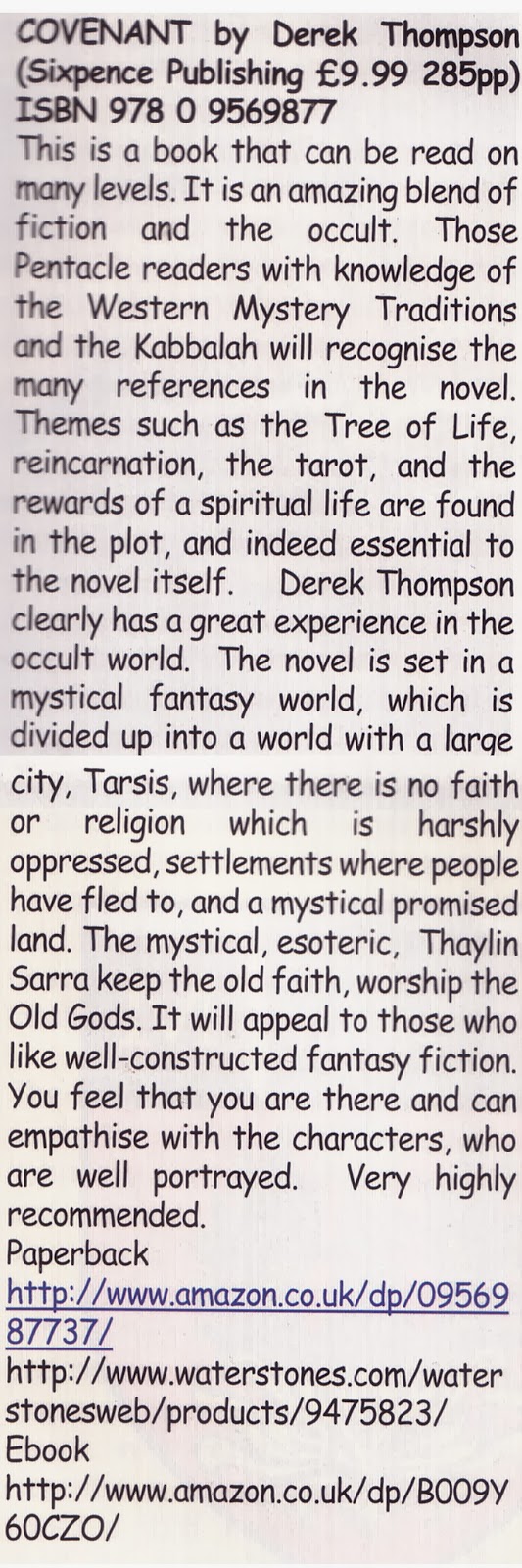
This review for my magical fantasy, Covenant, is from Pentacle - The UK's leading Independent Pagan Magazine. In many ways it marks a milestone for my book and for me.

How so?

Well, it's a review in a respected magazine - with readers who would likely enjoy Covenant. It's also a golden opportunity (there's that metal again) to promote not only those all-important sales links, but Covenant as a contribution to the Western Mysteries.

More importantly, it allows me to stop and reflect back on the work that went into Covenant - both the crafting of the story and the characters,  over many years, and the design of the esoteric elements. 

Sometimes, in the rush to get started on the next book, especially if the previous book has been slow to reach its audience, we can become dismissive of our achievements. I feel fortunate indeed to have received recognition from one of my peers. It feel like a nod from the Unseen for continuing with the book over its many adventures (deceased editor, 15 month wait for a response, publisher going under, etc).

The review pretty much says everything that I would want to say about Covenant. Whatever else happens with the book, I can feel confident that my aim was true. (At least until someone hates it!)

In fairness, there are practical benefits to a review like this as well:

1. My local branch of Waterstones promised to get in some copies, so I can now contact them to make good on their word. I'll keep you posted on how that goes.
2. A couple of independent bookshops have offered to display copies of Covenant alongside the review.
3. I've already had emails and given away review copies. In fact, tell you what, to celebrate the mag review, I'll give a PDF review version to the first five people to email me on asabovesobelow(at)btinternet.com, using the title: Covenant blog review.
4. I can add this review to my social media broadcasts.

Now, what was I saying about that next novel...


One year on

It's tempting to see the world of publication - and self-publicaton especially - as purely a numbers game. That makes for a simple equation: 'n' sales = 'n' success. Likewise, using that logic, small sales = small success. But is that always the case?

It's a little over a year now since I took the plunge and self-published Covenant, my fantasy, in ebook and paperback. I was always upfront with others and myself that it was never just about the money. That didn't even register on my top five list:
1. Get Covenant out there.
2. Get reviews.
3. See whether readers got the essence of Covenant, given its mystical and magical heart.
4. Learn about marketing (another form of mysticism and magic, as far as I was concerned), and what works for a book like mine.
5. Go into a bookshop and see Covenant on the shelf.

Okay then, maybe sales / money was hovering around six or seven.

So how did I get on and what have I learned?

1. Covenant is out there and I'm very proud of it. Both the ebook and the paperback versions benefited enormously from my having supportive friends with technical expertise of, on the one hand, formatting ebooks and negotiating the labyrinthine (to me) process of setting everything up on Lightning Source, and, on the other, turning a word doc into an actual book file. I also discovered that one more proofread is worth its way in gold (let me know how you do that). It's all fixed now, but early purchasers may find those few typos make it a collector's item in the years to come!
2. I have a clutch of reviews by people who clearly appreciate what Covenant is about. I mean the deeper stuff - the story behind the story. I can always use more though - just in case anyone is still holding back.
3. Some readers loved Covenant and wanted to discuss it with me. That was fun. Others found it too long and wordy (as opposed to numbery, which only applied to the top right of the page header). Them's the breaks, as they say.
4. What I learned about marketing and sales may be specific to me, but I'm the caring, sharing type:
a) Chain and independent bookshops are not that interested in self-published novels. You can chat for a few minutes, leave a paperback and an ebook on a disc, shake on it and still never hear from them again. They have a business to run and if you can't demonstrate the profitability of your book - or you get your timing wrong - you'd best chalk it up to experience.
b) Giveaways on Kindle help spread the word, but don't hound your Twitter followers with endless (if occasionally witty or ingenious) messages about your opus. Also, freebies do not automatically lead to reviews of any persuasion. I gave away about 300 copies and received a single review - but thanks anyway.
5. I regret to report that I'm still waiting to see Covenant on a shelf in a bookshop. I could sneak one in for effect and have someone take a photo of a delighted me, but that would just be cheating. 

So is that the end of the story then?
Not at all.

I know that Covenant will be a grower and I know that because my portfolio of books is growing. When I read about someone recently who'd written 20 books, I was envious of their productivity. And then I counted up my own books - published and unpublished, novels and others - and it totalled 13. Lucky for some. 

So, although at the moment Covenant is my only full-length novel in print and digitised, it won't be the last. And of course, at some point, there'll be the sequel.

I also know that tribe is really important and I struggled to find the ideal readership for Covenant. I didn't want fantasy readers to try it and find it too esoteric or occult, and I worried that readers of occult books would find it too lightweight to be considered a credible work on the subject.

To some extent I still have that argument in my head. I mean, is Covenant a mystical fantasy, an epic quest, a set of pathworkings, a spiritual allegory, or a book about magic?

The truth is that it's all of those things, and more. You see, that's the thing about a book - it's not just the characters that have lives of their own! It's true of any form of artwork: it is what it is. If you like it, that's genuinely brilliant for the creator. And if you don't, it's a bummer all round, so you'd best move on and find something else more to your liking.

However, if you do enjoy fantasy quests interspersed with ideas about reincarnation, the tarot, pathworkings, mythology, archetypes, magic, mysticism, allegory, the Western Mystery Tradition and the occult, Covenant could be just the thing. That also applies if you have a space in your bookshop!

You can purchase Covenant by clicking on the link: viewBook.at/Covenant 

"It's never about the thing that it's about."


You'd think that being a writer is all about two things:

1. Writing stuff.
2. Getting that written stuff published or at least read.

However, there's much more to it than that and I'll warn you in advance that I may get arty and soulful. To begin with, it's a helluva thing to even consider calling yourself a writer, never mind actually telling other people about it. Because, when it really comes down to it, every piece of writing contains a little bit of you in it - your memories, your perspective, your experience of the people around you, your hopes and also your fears.

It can feel like an indulgence to spend quality time away from loved ones and friends, especially when you're using that time to wrestle with people and situations that you've created in your head. Reading also takes on another dimension. What used to be a leisure activity now becomes a vital part of your craft. You still read for enjoyment, but you also look closely at style, plot, characterisation and all the other elements that already give you sleepless nights.

Or try this one on for size: A writer is an artist.
You write fiction? Congrats - you're an artist.

There's also a deeper, inner level to this writing journey. Julia Cameron's The Artist's Way is a brilliant resource (among others) for getting into the soul of writing. I believe there is a part of every writer that is secretly - and sometimes overtly, on the page - grappling with the big issues - life, death, justice, purpose, love, freedom, etc. 

Sometimes we not only express who we are on the page, we also explore who we wish we were. Read between the lines and it's as powerful as therapy and as real as it gets.

So, here's the thing: when someone tell's you they've written something, or that they're working on something, treat them with kindness. When you give feedback, make it constructive - it's fine to say you didn't like it, as long as you say why. Feedback on what you enjoyed - and why - is also welcomed. However, tell the truth.

Some writers will not get the recognition they deserve. For some, the only feedback they'll receive is the snipy kind on ebook sites or forums. But wherever writers are on that endless and invisible ladder of literary success (often in the eyes of other people) they stay true to their writing. Well, you wouldn't expect anything less from a writer, would you?

Peace


"Peace is a decision, a process, a journey, a commitment. It comes from the desire for stillness within and balance without. It requires vision, to see what can be and not be trapped in what has beenWe always live in the shadow of those generations who came before us, as beneficiaries of their struggles, their generosity and also their mistakes. But we honour them - and ourselves - by the way we live now."

Living with PTSD - a UK exhibition


Creativity serves many purposes. It can take us on journeys of the imagination, enable us to present new and interesting ideas to others, and even allow us to begin to heal. 

My friend, Villayat 'SnowMoon Wolf' Sunkmanitu, uses photography and poetry as a coping mechanism for living with PTSD and also as a way of raising awareness about PTSD and the therapeutic benefits of creativity.

Having produced Words of a Wolf, The Way of the Wolf and Soul of a Wolf, he has created an exhibition, Living with PTSD, which shares his work along with insights he has gained from the spiritual traditions of the Native American Lakota tribe. 

The exhibition will be housed at various locations across the UK and is showing from 5th - 30th November 2013 at Leicester People’s Photographic Gallery, 2 Wellington Street, Leicester LE1 6HL.


There will be a chance to meet Villayat on the opening night from 6:30pm – 9pm on Tuesday 5th November 2013.  You can find out more about his work by visiting his website: www.wolf-photography.com

He would also be happy to hear from you if you have a suitable UK venue for hosting the exhibition. Please contact him via his website.


VILLAYAT ‘Wolf ’ Sunkmanitu has gone to extreme lengths to cope with the daily struggles of post traumatic stress disorder. The former RAF policeman, who was stationed in Northern Ireland in the mid 1980s, has been down the conventional route of NHS therapy and private counselling sessions and tried less orthodox methods by spending time with Native American tribes who practise healing ‘Earth Medicine’.  Staying mainly with the Lakota tribe of the Great Plains in North America helped him explore the root of his PTSD.

The 49-year-old, who grew up in Highfields, Leicester, says: “When you’re learning about ‘medicine tools’ from teachers of this path, you’re learning about working on your spirit – your soul – and it’s a holistic form of medicine that affects your mind and body too.”

Numerous visits to indigenous tribes also enabled him to explore an affinity he feels with wolves and is where the name ‘Snow Moon Wolf’ was bestowed on him by one of the teachers, White Eagle. There, in the wilderness, he was able to photograph wolves and for once, away from the rat race, he felt at peace.

Photography is not the only coping mechanism he has found to handle PTSD, which has wrecked his opportunities to work and forced him to retire on health grounds.  Poetry is also a form of creative therapy – although his poems don’t make comfortable reading.  Titles such as Inner Turmoil, Survivor and Demons in my Soul clearly expose the torment, alienation and stigma he feels.

Villayat, who was born to Indian parents in the UK, says: “PTSD can be very debilitating. When you have a physical injury that people can see, they seem to be more comfortable with you than dealing with an invisible wound.

Villayat went undiagnosed for 12 years – a time he refers to as “hell.” As well as his own emotional difficulties, there’s a sense of injustice and anger about the way he believes many veterans of the Armed Forces have been let down by politicians.

It is 30 years since Villayat left the RAF. He was 19 when he was sent to County Down, Northern Ireland, for a two-year tour in 1983, assisting the RUC and other units engaged in counter terrorist activities. He attributes the mental scars to suppressing his fear during incidents he was involved in as part of his duties and an explosion in Belfast. Anxiety, hyper-vigilance, depression, forgetfulness, disturbed sleep and flashbacks became part of his everyday life and it wasn’t until 1995 that he was officially diagnosed with PTSD after a serious road accident.

Even after diagnosis and treatment, he still can’t cope with busy places or potentially troublesome places so he avoids pubs and concerts and would rather be in the wilderness than walk down a city street.

The Long and Winding Road


Name that song...


This blog post is a combination of three of my favourite things (no...not that...and not that either...) - serendipity, The Beatles and writing.

As you'll have read on this blog - and many others - a modern assumption, aided and abetted by the Internet and social media, is that you can gameplan your way to writing success. Masterclasses, editorial consultants, workshops, agents, publishers, street teams, and comprehensive strategies - all these and more, we are told, will assure you of eventual success. 

Now, before we get into a hoo-ha, let me state for the record that I have no issue with any of the aforementioned in themselves. Why would I when I can personally tick them off my own list (apart from a masterclass, which I couldn't afford!).

But...I'm acutely aware of the role that serendipity has in creative success, and I think it's so often underplayed. To illustrate my point, here is an extremely potted history of The Beatles.

The early line-up was John Lennon, Paul McCartney, George Harrison, Stuart Sutcliffe and Pete Best. Stuart left the band to concentrate on his art studies. Brian Epstein saw the band at the Cavern Club, liked them and became their manager in 1962. The same year, Decca Records rejected the group, commenting that: "Guitar groups are on the way out, Mr. Epstein." Despite that sage advice, George Martin subsequently signed them up for EMI's Parlophone label. Stuart Sutcliffe died tragically, aged 22. Ringo Starr (who'd previously been part of Rory Storm and the Hurricanes) replaced Pete Best, a move not universally popular with fans. A total of 12 original UK albums were released between 1963 and 1970, along with over 50 singles. After the band separated in 1970, all four Beatles went on to have solo careers, along with Paul McCartney creating Wings and George Harrison being part of The Travelling Wilburys. John Lennon was murdered in 1980 and George Harrison died in 2001.

Beatle related controversies include:
1. Pete Best being ousted from the band.
2. The original 'butcher' cover on the compilation album Yesterday and Today. 3. John Lennon's oft-quoted (usually out of context) comment about The Beatles being 'bigger than Jesus'.
4. Their time with Maharishi Mahesh Yogi.
5. More recently, Paul McCartney asking for some songs to now be credited to McCartney / Lennon rather than the other way around.
6. A lawsuit against George Harrison's My Sweet Lord brought by Bright Tunes for alleged copyright infringement of the Ronnie Mack song 'He's So Fine'.

I know, all too brief and not enough detail. Buy some books instead!

My point, other than to stimulate your Beatles-related curiosity, is to remind all us writers that fate, chance, or circumstance - call to what you will - has its part to play. Hindsight can make the improbable seem inevitable, and we never fully appreciate all the factors that contribute to success.

They can include:
- Inspiration and influences
- Talent
- Meeting the 'right' people for something to happen
- Making connections
- Timing
- What's going on in the world outside your creative endeavours
- Motivation
- Who's backing you and what influence they have
- What came before you
- What you encounter once you've generated some momentum
- Any controversy you become embroiled with
- How people feel towards you and your creative output
- How long it takes to reach sustainability
- Economics - yours, the business's and the marketplace


Or, as the Fab Four might have put it themselves: I Don't Want to Spoil the Party - What Goes On - All You Need is Love - I Should Have Known Better - We Can Work It Out - With a Little Help from My Friends - Misery - Revolution - Paperback Writer.

Guest spot - Laurence O'Bryan - The Themes of The Manhattan Puzzle


I'm delighted to present a guest post about author Laurence O'Bryan, who writes modern day mystery-thrillers with a twist or three. First there was The Istanbul Puzzle, which necessitated six visits to Istanbul for research (now that's commitment!). Then came The Jerusalem Puzzle, which continued the story and features the same characters. And now, there's the third book in the series, The Manhattan Puzzle, which launches October 10, 2013.


Interesting facts about Laurence in his own words (with additional comments from me in italics).

I was first published by a school newspaper when I was ten. (Start young if you can.)
The Istanbul Puzzle was shortlisted for the Irish Crime Novel of the Year Award 2012. (Get your work out there.)
My roots go back to a small estate deep in the Mountains of Mourne, near the Silent Valley, in County Down, Northern Ireland. (Recognise your own history and heritage.)
I went to school in Dublin, drank way too much, studied English and history, then business, then IT at Oxford University. While a student, I worked as a kitchen porter in a club near the Bank of England. (Live a full life and incorporate it into your writing along the way.)
I have also published a guide to social media called, Social Media is Dynamite. (Diversify!)

Laurence's top tip for writers

"Don't expect easy success, it's an illusion, and don't expect to find a short cut, there's only the long way, but do expect to become a writer through the torment and toil that will make you one."

The Themes of The Manhattan Puzzle
By Laurence O’Bryan

What has been hidden in Manhattan by the most powerful people on earth?
What would you do to a Manhattan banker who treated ordinary people like slaves?
What magic is buried under Manhattan that allows it to rise again from anything the world throws at it?
The BXH Bank Building NYC
BXH Bank building, Manhattan, vehicle entrance visible under the arch.
Image © LP O’Bryan

These are the themes of The Manhattan Puzzle. The story sees Sean and Isabel (my characters from The Istanbul Puzzle and The Jerusalem Puzzle) reunited in Manhattan at the headquarters of one of the world’s largest banks, BXH. There’s been some grisly murders, and now the plot takes a new twist. The contents of the book they found in Istanbul are revealed.
My personal journey with this story grew out of my disgust at the financial crisis that has brought many so low. I am interested in the myths and the beliefs of those who value money above everything.
But The Manhattan Puzzle is about other things too. For instance, what would you do if your partner didn’t come home one night? And what would you think if the police turned up at your door the next day looking for him?
Relationships are under stress everywhere, because of the demands placed on us by our jobs, but few of us will face what Isabel has to face when Sean goes missing. 
There is violence from the start in The Manhattan Puzzle too, but the opening has a woman inflicting it on a man. I am tired of reading about men inflicting sexual violence on women. I think it’s time for the handcuffs to swop wrists. And they certainly do in The Manhattan Puzzle. You can download the first chapter here as a pdf.  
But don’t get me wrong. I love Manhattan. It’s a city in a snow globe of dollar bills. So look in your bookstore and on your E-readers and order it too, if you want. 
To order The Manhattan Puzzle click here.
Or to visit my website click here.
And thanks for reading this and for buying The Manhattan Puzzle, if you do. I hope you find it entertaining and the themes interesting.