Showing posts with label Covenant. Show all posts

Hats off to writers

Nature's hatstand
I love a good back story. Now we've decided to shorten the third Thomas Bladen thriller I've been busy doing some pruning. Any cut scenes, flashbacks and dialogue will survive as background info for the series - for me.

One of my battle cries is: Context matters. If you're a fan of The Monkees, you'll know and love 'Pleasant Valley Sunday' but try the Carole King version (she write it with Gerry Goffin) and you get a completely different take on it. Or maybe you're a fan of Dylan's Tambourine Man but you don't really know Melanie's version, where the lyrics turn from rebellious to soulfully melancholic.  

One song can be interpreted so many different ways. A scene, even one line of dialogue, can be rendered as comedy, tragedy, or high drama. Writing, like other art forms, can be nuanced and subtle. That's the case for artists too.

Writers can easily become pigeonholed. I've mentioned before (somewhere in this blog, I think) about the time someone read my magical fantasy, Covenant, and remarked that it was like a clown trying to write Shakespeare. The comment's kinder than it sounds, honest. I was a bit of a jokesmith at the time. Writers can buy into the belief that they may only wear one hat but it's just that - a belief.

Recently, I had a visit. Well, a remembrance really. Just a name - Stephen Heick - that popped into my head. He was a character from a book I wrote (and burned) in my teens. It was a brief visit and, in my imagination, he acknowledged me with a touch of his temple, and walked on through the scene. I haven't thought about him in a long time, although a character from his book did appear in Standpoint. 

As the third Bladen novel draws to a close so my eager publisher can turn it into a book, I've had time to reflect on what an extraordinary journey it has been since the contract was signed in January 2015. Three novels available in a year has far exceeded my expectations. It's also happened at such a pace that my writing cupboard (we all have them, trust me) is getting bare. For fans of the Bladen series, Book 4 is being sketched out by the sleeping part of the my brain.

But those other hats...
1. My standalone transatlantic comedy drama, Scars & Stripes, is still in need of representation.
2. I keep my hand in with gag and sketch writing, which results in a nice little cheque from time to time.
3. There is talk of another edition of As Above So Below magazine. Possibly.
4. I have a new standalone novel in mind, involving time-travel and second chances.
5. A novella about a man whose dead brother rings him up for a chat from time to time.

Thriller writer, jokesmith, clown trying to write Shakespeare, fantasy author, magazine co-creator, comedy novelist. Guilty as charged, with another seven offences I'd like taken into consideration. 

I'm a veritable hatstand - and so is every other writer.

The Value of Feedback

It's said that a true friend is one who will tell you what they really think - and why. For a writer, getting reliable feedback is invaluable. Just as a good proofreader can spot those rogue apostrophes and homonyms that you read past without noticing, so a good reviewer can tell you the essential and occasionally bitter truth. 


One must use discernment these days, of course, when reading social media and online book reviews because they offer such a wide canvas for jealousy, mean-spiritedness and invective, as well as encouragement, support and constructive feedback - if you're lucky. 


It's all in the game, I suppose, and for every book that's praised to the rafters there will also be a proportion of readers who thought it stank like last week's haddock. In fact, I received what must surely rank as the worst review I'll ever receive (on that site at least!). If I tell you it was for my magical fantasy, Covenant, and on one of the major - and tax ambiguous book retail sites, you can easily find it if you're curious.


I'll wait for you...

Ah, there you are. What did you think? Me? I was both disappointed and amused by it. Firstly, it suggested that I hadn't given the reader something of value - which is what I think most writers strive to do, irrespective of the topic or genre. Secondly, it amused me because I'd be hard pushed to get a review that bad again under any circumstances. (Although no one has reviewed my gag ebooks yet...)

The real worth of feedback, to me, is that it's an indication of whether I've succeeded - in the reader's eyes - in parceling up my ideas, feelings and themes into a cohesive package. More than that, where it's fiction, I want them to have felt something. Where my reviewer, who didn't like Covenant, is concerned, I can at least be certain that they felt something!

Many months ago I spoke with my editor at Musa Publishing about finding out if my mid-grade book about bullying and transformation, superhero club, might be suitable as an education or support tool. With their blessing, I contacted two organisations connected with young people's well-being, as well as a couple of local schools in Cornwall. The schools didn't respond, but eventually, after some polite reminders - over five months and one year respectively - the two organisations said they either didn't have time or were not in a position to review my book. And you thought agents and publishers took a long time...

Undeterred, although frankly pretty ticked off by the experience, I contacted two more organisations, and almost immediately (within a day or so), I had responses from each. (Note to self: choose wisely in future and perhaps ring up first.)

One organisation has now provided three brilliant pieces of feedback, yielding some unexpected comments. Remember the context here - this feedback is from professionals working with vulnerable / troubled children.


Pros

- Suitable for a young person who enjoys reading.
- Liked the style and conversational approach.
- Felt it illustrated the benefits of talking therapy.
- It's simple and gets to the point, making it quite accessible. 
- It gives awareness that adults have issues as well.
- An interesting story covering various issues, giving an insight into how bullying affects people.- A very touching story and easy to follow, it could help a young person understand how a group could help them.

Cons
- Didn't like the use of American English although it probably wouldn't be a problem for young people.
- Concerns that the group of young people in the book were copying the bullying behaviour towards the bully.
- Some of the language was difficult for some children to understand.
- The supportive group of young children bullied the bully and the teacher just ignored the situation, sending out a negative message to vulnerable children readers that there's no point in telling teacher as they won't do anything about it anyway.

I'm indebted to the reviewers because it has given me a completely different perspective on my children's book. 

It all raises some interesting questions:
1. Would a rewrite of Superhero Club turn it into a useful educational / support tool?
2. Would a rewrite of Superhero Club increase its popularity?
3. If I hadn't had that feedback from professionals, would I have been content with the book as it stands?
4. What would my publisher, Musa think?

I was talking recently with abstract artist Harriet Hoult, who will be guesting on this blog soon, and she felt that each piece of art she produced had its own conclusion. Perhaps every piece of creative output, once it exists in the outer world (i.e. beyond a drawer or a file on a desktop), has become what it was supposed to be. Maybe, where a book or a story is concerned, revisiting and editing after that point only unravels all the elements that put it together in the first place? 

What's your feedback on that?


Room for a Review

All writers love feedback. Granted, some of those early nuggets of insight may have stung like a somersault into a wasps' nest; and even some of the later, apparently well-meaning critiques were as welcome as a phone call to discuss your gas supplier when you're desperate to reach the loo.

But a review that gets the essence of your novel and still finds positive things to say about it to other people? Well, that's worth its weight in alchemist's gold.

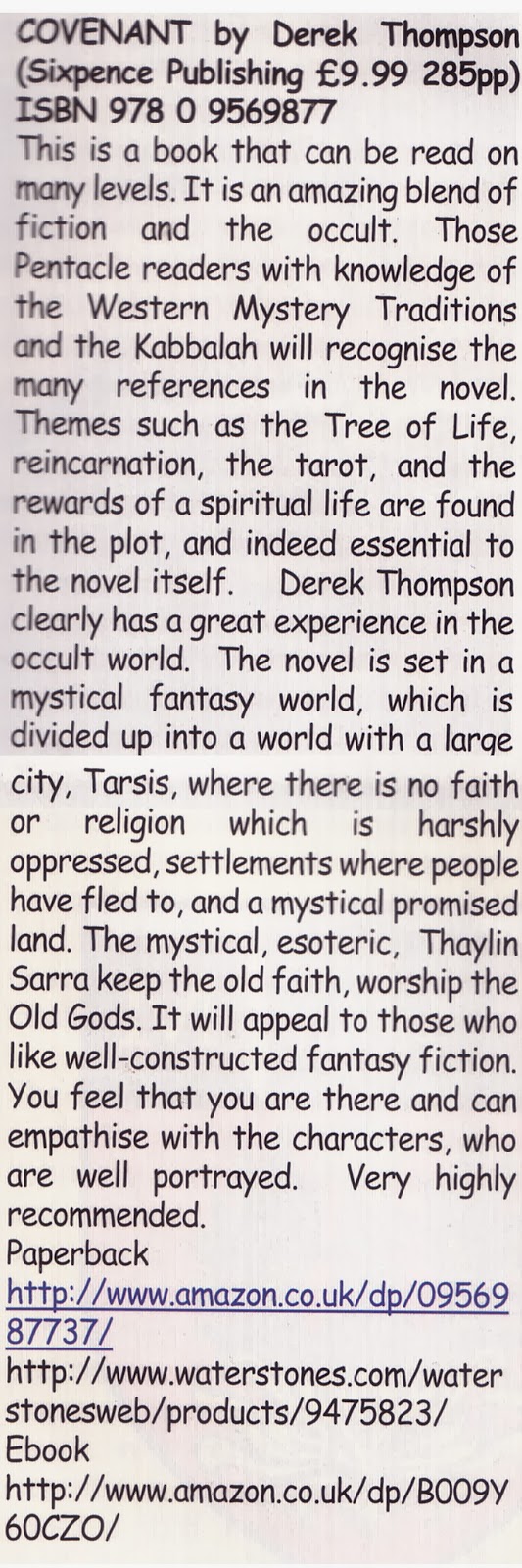
This review for my magical fantasy, Covenant, is from Pentacle - The UK's leading Independent Pagan Magazine. In many ways it marks a milestone for my book and for me.

How so?

Well, it's a review in a respected magazine - with readers who would likely enjoy Covenant. It's also a golden opportunity (there's that metal again) to promote not only those all-important sales links, but Covenant as a contribution to the Western Mysteries.

More importantly, it allows me to stop and reflect back on the work that went into Covenant - both the crafting of the story and the characters,  over many years, and the design of the esoteric elements. 

Sometimes, in the rush to get started on the next book, especially if the previous book has been slow to reach its audience, we can become dismissive of our achievements. I feel fortunate indeed to have received recognition from one of my peers. It feel like a nod from the Unseen for continuing with the book over its many adventures (deceased editor, 15 month wait for a response, publisher going under, etc).

The review pretty much says everything that I would want to say about Covenant. Whatever else happens with the book, I can feel confident that my aim was true. (At least until someone hates it!)

In fairness, there are practical benefits to a review like this as well:

1. My local branch of Waterstones promised to get in some copies, so I can now contact them to make good on their word. I'll keep you posted on how that goes.
2. A couple of independent bookshops have offered to display copies of Covenant alongside the review.
3. I've already had emails and given away review copies. In fact, tell you what, to celebrate the mag review, I'll give a PDF review version to the first five people to email me on asabovesobelow(at)btinternet.com, using the title: Covenant blog review.
4. I can add this review to my social media broadcasts.

Now, what was I saying about that next novel...


One year on

It's tempting to see the world of publication - and self-publicaton especially - as purely a numbers game. That makes for a simple equation: 'n' sales = 'n' success. Likewise, using that logic, small sales = small success. But is that always the case?

It's a little over a year now since I took the plunge and self-published Covenant, my fantasy, in ebook and paperback. I was always upfront with others and myself that it was never just about the money. That didn't even register on my top five list:
1. Get Covenant out there.
2. Get reviews.
3. See whether readers got the essence of Covenant, given its mystical and magical heart.
4. Learn about marketing (another form of mysticism and magic, as far as I was concerned), and what works for a book like mine.
5. Go into a bookshop and see Covenant on the shelf.

Okay then, maybe sales / money was hovering around six or seven.

So how did I get on and what have I learned?

1. Covenant is out there and I'm very proud of it. Both the ebook and the paperback versions benefited enormously from my having supportive friends with technical expertise of, on the one hand, formatting ebooks and negotiating the labyrinthine (to me) process of setting everything up on Lightning Source, and, on the other, turning a word doc into an actual book file. I also discovered that one more proofread is worth its way in gold (let me know how you do that). It's all fixed now, but early purchasers may find those few typos make it a collector's item in the years to come!
2. I have a clutch of reviews by people who clearly appreciate what Covenant is about. I mean the deeper stuff - the story behind the story. I can always use more though - just in case anyone is still holding back.
3. Some readers loved Covenant and wanted to discuss it with me. That was fun. Others found it too long and wordy (as opposed to numbery, which only applied to the top right of the page header). Them's the breaks, as they say.
4. What I learned about marketing and sales may be specific to me, but I'm the caring, sharing type:
a) Chain and independent bookshops are not that interested in self-published novels. You can chat for a few minutes, leave a paperback and an ebook on a disc, shake on it and still never hear from them again. They have a business to run and if you can't demonstrate the profitability of your book - or you get your timing wrong - you'd best chalk it up to experience.
b) Giveaways on Kindle help spread the word, but don't hound your Twitter followers with endless (if occasionally witty or ingenious) messages about your opus. Also, freebies do not automatically lead to reviews of any persuasion. I gave away about 300 copies and received a single review - but thanks anyway.
5. I regret to report that I'm still waiting to see Covenant on a shelf in a bookshop. I could sneak one in for effect and have someone take a photo of a delighted me, but that would just be cheating. 

So is that the end of the story then?
Not at all.

I know that Covenant will be a grower and I know that because my portfolio of books is growing. When I read about someone recently who'd written 20 books, I was envious of their productivity. And then I counted up my own books - published and unpublished, novels and others - and it totalled 13. Lucky for some. 

So, although at the moment Covenant is my only full-length novel in print and digitised, it won't be the last. And of course, at some point, there'll be the sequel.

I also know that tribe is really important and I struggled to find the ideal readership for Covenant. I didn't want fantasy readers to try it and find it too esoteric or occult, and I worried that readers of occult books would find it too lightweight to be considered a credible work on the subject.

To some extent I still have that argument in my head. I mean, is Covenant a mystical fantasy, an epic quest, a set of pathworkings, a spiritual allegory, or a book about magic?

The truth is that it's all of those things, and more. You see, that's the thing about a book - it's not just the characters that have lives of their own! It's true of any form of artwork: it is what it is. If you like it, that's genuinely brilliant for the creator. And if you don't, it's a bummer all round, so you'd best move on and find something else more to your liking.

However, if you do enjoy fantasy quests interspersed with ideas about reincarnation, the tarot, pathworkings, mythology, archetypes, magic, mysticism, allegory, the Western Mystery Tradition and the occult, Covenant could be just the thing. That also applies if you have a space in your bookshop!

You can purchase Covenant by clicking on the link: viewBook.at/Covenant 

Once upon a tome...


Hang out the flags, I've got an idea for a story.
We tend to see events and perspectives from the beginning of things, without always appreciating the beginning (or the ending) before the beginning.

Sometimes, it's the 'why'.

Why was the 'wicked fairy' in Sleeping Beauty wicked?
What drove Laurie Lee to start his journey in As I Walked Out One Midsummer Morning?
What made Craig Campbell choose his way of life in Sinclair Macleod's The Reluctant Detective series?

When it comes to novels, I think that authors juggle three distinct needs.

What does the reader actually need to know, what does you need them to know, and (still with me?) what do you need to know purely for yourself?

Initially, in my Brit thriller, Standpoint, I alluded to main character Thomas Bladen's difficult childhood. But the more I wrote, the more I wanted to know what actually went on. So I explored that and some of those formative events filtered through to the manuscript. That way the reader can trace a thread all the way from who my protagonist is all the way back to some of the experiences that moulded his behaviour.

Even if you're writing about a baby, its home environment and the attitude of its parents (which will contribute to its conditioning and the life awaiting it) owe a debt to the past.


I'm in the process of submitting two novels to agents / publishers (at time of writing, I haven't decided which road to take). To complicate things further, each book is a different genre. Standpoint is a thriller about a civilian who joins the UK's Surveillance Support Unit, while Scars and Stripes is a transatlantic comedy drama set in the 1980s. 

Being back on the submissions trail, it's easy to buy into the notion that I'm there at the beginning. Except that I'm not. My trusty spreadsheet reminds me that I've been contracted four times for other books, and offered a further three contracts (at different times) for a fantasy novel, Covenant, that I eventually chose to self-publish.

As writers we tend to see ourselves at the start of something, which can be energising or daunting depending on how you feel about that all-important next stage. But it's important to recognise the steps and individuals (seen and unseen) that brought us to this point. 

The journey of a thousand miles may well begin with the first step, but let's not forget all the other journeys that put us there, willing and able.

What goes around

Not the prettiest image, unless you're a jobbing writer.
I've said in the past that I'm a big fan of short story competitions. You are usually presented with a theme, a word count and a deadline - and all for no more than a nominal entry fee (we can have that debate some other time).

Even if you don't win a prize, you've still come out on top because, if you've written something new, you'll have an original piece of work inspired by the comp requirements. Which means you have something else to add to your portfolio, sell on, use in a blog post, or rework into something different.

But, let's face facts for a moment, the big happy ending is becoming a prize winner. So allow me to share my joy at getting a 'olympic silver' in the Arc / Tomorrow Project fiction competition, for Perfect Circle.

My thanks to Intel, New Scientist. Reed Business Information and Simon Ings.

But mostly, my thanks to Write This Moment for bringing the competition to my attention. Another year's subscription that was money well spent! 

Perfect Circle tells the tale of Billy Cloudsbury, who finds out he has a deceptively simple - and rare - talent. You can read the story here.

Now, some of you out there have been asking about my fantasy, Covenant, which is due for self-publication this month. It's still on the way in paperback and I'm also playing around with ebook formats. Expect an announcement in the next two or three weeks.

And then there's the tale of a hellish takeover, but that's another story altogether!


The End of the Affair


With few exceptions, most of the posts you will ever read about the practice of writing, anywhere on the Internet, will be positive. Sure, there'll be the occasional I submitted my novel to 11 agents...' but the punchline will usually be, 'and the 11th submission came up trumps'.

This post will be a little bit different.

This tale is what you might call the flip side of the coin - the side that lands in the dirt. And pretty much stays there. Except that, viewed from another perspective, it doesn't. This affair is a literary one and full of contradictions.

We'll start at the beginning. Well, not the very beginning because that took place a long time ago - in the 1980s.

My fantasy, Covenant, is a large book. It weighs in at 133,000 words and, believe me, that is the shortened version. It's a quest that involves a range of themes, both archetypal (truth, loss, justice and redemption) and esoteric (altered states of consciousness, reincarnation, and mysticism). Even for the fantasy genre, based on the feedback I've had, I'd say it's a little different.

It has been a long journey. You can find snippets elsewhere in this blog, but the facts are these:

- 20 submissions to agents.
- 40 submissions to publishers, which include Indies.
- Subbed in the UK, USA, The Netherlands, Denmark and South Africa

- Fastest decision time - 1 minute (no unsolicted subs at the moment, thanks).
- Slowest decision time - 1 year, 3 months and 16 days (Baen Books).

- Five contracts offered.
- One was solely for ebook publication.
- One was for a very limited print run.
- Three wanted author contributions from £1000 to £5000.
- One publisher wanted me to commit to buying 150 discounted copies.

High points:
- Being offered each and every one of those five different contracts. Okay, so I declined on the basis of my costs or their distribution model, but in each case - had I the available funds or the profile - it might have worked out. Bottom line? Publishing is a risky business and they wanted me to share the risk.

Low points:
- My editor at Samhain, Terri Smith, approving my book and then passing away before the revised contract could be signed. Followed by the replacement editor turning my book down.
- My ms or return postage not being returned by Capall Bann, and no reply to my phone call / registered letter. And this was after they'd sent me a proposal.
- Saga Whyte Press falling victim to the global downturn before my launch.
- The agent who wanted the 'small amount' of £70 to read my ms sample.

And after affairs, so I'm told, once the recriminations and rationalisations are little more than fading memories, there's a fresh perspective. Maybe it's not always forgive and forget, but it's learn the lesson and move on. The lesson for me was that, after years of subbing and editing, and all of the above, I decided that I don't want to do it anymore. Not with Cov. I do, however, want to see Cov in print.

It took Villayat SnowMoon Wolf Sunkmanitu, a fellow writer and photographer, less than 30 minutes to talk me through the pleasures and pitfalls of paperback self-publication. I know, from the feedback I've received, that there's a niche readership out there. And I used to have a reader group of around 30 people who received a chapter a week. So here's to the end of the affair and the onset of independence.

I aim to complete the proof edit by the end of July and commit to print in August / September.  And I'm waiting to hear about using a cover design from one of my former editors. So watch this space, and if you're into esoteric fantasy epics, you're welcome to join my mailing list. 

A Lovable* Rogue at the Halfway Point

It's that time of the year when many writers see one of their seasonal offerings thrust out into the world. I'm talking of course about today, June 30th, being the halfway point in the calendar year.

It's a good opportunity to pause and reflect and, as every ex project manager knows, it pays to review your progress at regular stages and see where the hell you are in relation to where you'd planned to be.

The latest good news is that a classic sci-fi story of mine called Rogue is included in Beyond the Horizon, published by Alasdair Firth's Bamboccioni Books at the end of July. This brings my 'ISBN by association' tally to three this year (the others being The Wanderer and Coffee Shop Chronicles Vol 1). So far so good. I've also put together my first ebook - a drama resource of comedy sketches for non-profit use. A good friend of mine is, as we speak, combing through the collection of 30 or so sketches and probably weeding out the ones that relate to religion, sex and drugs. I haven't quite figured out where it will be sold, but I have heard good things about Smashwords so that's a possibility.

Longer term business clients have been crossing my path with e-silver, which is always gratifying. Meanwhile, my novels Covenant, Standpoint and Line of Sight continue to circulate through the letterboxes of agents and publishers, which I consider a bit of a no-score draw. As all writers know, submission is very much a waiting game with occasional pauses. But, in the spirit of the midpoint, I have chased up three contacts today to find out about my other submissions (you didn't think that was ALL I was working on, surely!).

There have been one or two casualties along the way. I achieved my goal of a magazine column then promptly lost it upon the altar of economics. It was fun while it lasted although fun and well paid would have made for a more enjoyable experience. Still, one can't have everything. And I've already mentioned the client who thought my working for two hours gratis would be an excellent way to demonstrate my ghostwriting skills. Gone but not forgotten.

My all-seeing spreadsheet tells me I have:
6 books collectively awaiting 11 responses
7 short stories collectively awaiting 11 responses
33 magazine submissions, pitches and queries awaiting a response

Anyway, I can't sit here yapping all day - I have a deadline to meet. Here's to the next six months!


* Spelling approved by my trusty copy of Guardian Style.

Are you keeping it real in your writing?


I was in the Co-op today and I got the munchies. Luckily, a packet of chilli crisps caught my eye, primarily because of its proud boast: made with real ingredients. I'm sure we can all remember the bad old days of counterfeit ingredients in our savoury snacks. Once I'd emptied the packet - and scanned it in for posterity - I thought about how it could apply to writing.

As a writer, I strive for a sense of realism in my fiction. Whether it's Thomas Bladen working out who he can trust in Standpoint, or Syriem Taulpiris negotiating his way through a mystical journey in Covenant, there's always a set of conventions that apply. My readers may have agreed to the suspension of disbelief by turning the pages but, as Samuel Taylor Coleridge inferred, it's the writer's job to keep it that way until the last page. Or preferably, afterwards - because if they're still thinking about 'What Syriem did next' then they'll probably want to read more of my work..

Plot, point-of-view, characterisation, dialogue and pace must all work harmoniously to create a reality so enticing that they'll prefer it to the world they know, for a time. A key element of that is the authenticity of the emotions. Even if we haven't faced a bullet, known personal disaster or seen death up close, we have all known fear and loss. We may not have experienced an epic love that took us across continents or worlds but we all know what love feels like to have or to be denied. Childhood alone will teach you most of that!

Generally, the only things that I find dilute that authenticity of the emotions are intellectualising what I think a character is feeling or not allowing myself to go deeply enough into a scene. Either way, it's holding out on the reader and that's a big no-no. It might seem like it's all been done before but each time we feel something - really feel it - it is as fresh or as raw as the first time. Sometimes, even more so because it reconnects us with ther past.

And just as there are only so many ingredients in a snack (it was the first time I'd seen Calcium Chloride listed as a firming agent), so there is a finite number of ingredients to a book. The trick is to create a unique recipe, resulting in a distinctive flavour that will satisfy your customers again and again.