Picture This
One, two, free.
Who? What? Where? Wye!
![]() |
| This writing business will be the death of us. |
Guest spot - Seshu Kiran GS - The Art of the Matter
![]() |
| Arizona by Seshu Kiran GS, used with permission of the artist. |
Story time
![]() |
| An early form of tablet, which wasn't very portable. |
- Engage the reader and draw them into the story.
- Eliminate waste and distraction.
- Remove the author from the equation.
- Give the reader a satisfying ending that will still leave them wanting more.
In my novel, Scars & Stripes, Alex is walking down a street in the St Mark's district of Manhattan when he sees a sign on a window: What's Your Story? Led by curiosity, Alex winds up in an apartment where a bespectacled dude is hunched over a typewriter (it was the 1980s), working on a collection of other people's stories. For the sci-fi aficionados among you, this could almost be Alex's future or parallel self. It could, if it was that sort of novel.
Arguably, that scene is a metaphor for one of the novel's central premises - Alex is one of life's observers, but he also remembers small things that other people forget. The novel, and therefore Alex's story, is actually filled with the stories of other people he encounters. In the scene I mention above, Alex sells some of his real life stories (albeit fictionalised by bias and ego) to the writer who then creates something new out of them for a magazine. Ironically, Alex encounters one of those magazines, further down the line, and barely recognises his own history in there.
We're all enthralled and enchanted by stories from an early age. The structure of fairy tales and traditional bedtime stories has been pawed over by mythologists and experts to reveal common threads and forms. I've also mentioned, elsewhere on this blog, how researchers like Joseph Campbell identified commonalities found in the mythologies of different and unconnected cultures.
Like many other writers, I do read online reviews of other people's work and I'm struck how often the critics denounce the typos and grammar, or the two-dimsnional characterisation, and how rarely they turn their attention to the actual story itself. It seems to me that if the story engages the reader and captivates them, even if the writing was deemed below par, the author as on to something.
I'd argue that stories are a rich and vital part of our psyche, individually and collectively. Stories makes us feel, consider, react and yearn. Whether it's in a theatre, at a cinema, watching the soaps or Jeremy Kyle, or even reading a book (remember those?), stories bring us to life.
If you'd like to read some of my own short stories, here are some handy links:
The Silent Hills - a 5000 word tale of suspense and revelation.
Coffee Shop Chronicles - an anthology containing my story, Diner.
Beyond the Horizon - an anthology containing my sci-fi story, Rogue.
Kissing Frankenstein - an anthology containing several of my really short stories.
Saturday Night - a little slice of Americana for free (partly inspired by Raymond Carver).
*It wasn't an old joke - I made it up. Feel free to quote me on it.
Seven Painful Truths About Social Media
![]() |
| Best foot forward. |
A Public Service Announcement
If you write books, you need to reach an audience. Preferably, one with a voracious reading habit and plenty of spare cash. After you've exhausted your relatives and friends (literally, in some cases), the internet seems to glimmer like a golden gateway to prosperity, success and authorial fulfilment. Hold that thought. Why don't you sit down? There are some things you need to know.
1. People will follow you on Twitter, so, naturally, you follow them back. And then...in the dead of the night...they unfollow you. It's like the kid at school who got you to share your sweets and then the next day they scoffed all of theirs without telling you. Sneaky.
However, there are online tools you can use, such as Tweepi, to decouple yourself from those finaglers (love that word!). Also, don't follow someone back without first checking what they're about. If you're trying to promote your writing, hot dates in your local area or I can get you 5000 followers for $15 probably doesn't reflect well on your creativity.
2. Many people may follow your blog (hurrah), and post comments (hurrah deux), just to lay a trail of breadcrumbs back to their own blog. This needn't be a bad thing if their blog interests you and / or you can add insightful or interesting comments on their blogs in return. However, that doesn't mean you have to accept every comment. Naturally, you've tweaked your settings to ensure you approve each comment before it's posted?
3. Facebook likes mean nothing. Okay, you might get a brief and warm tingly feeling, but if you're plugging a book - preferably on its own Facebook page, by the way - what you really want people to do is share your post and preface it with a comment of their own.
You could use a tool like Networked blogs, although, in the interests of balance, not everyone agrees.
4. You can't be everywhere at once, all the time. Or, indeed, at any time. Experiment with social media, see what works and what's fun (which may not be the same thing), and keep in mind why you're using social media in the first place.
5. Once you have a prominent and active social media profile - one which hopefully brings your books to a wider and appreciative audience - your relationship with your audience will change.
Ideally, any questions you're asked about your work will form the basis of further posts, allowing you to engage with your readers and supporters in, if not real time, then something fairly close to it. Just as, by definition, you can't have a dozen BFFs, you should not expect - or lead others to expect - an intimate connection with too many of your readers.
6. There are so many social media platforms and tools that it's scary. If you think I'm exaggerating, here's a handy list. A little discernment goes a long way.
7. Social media can cloud your judgement and waste your time. You can easily spend valuable writing time chasing popularity, joining other platforms because A N Other invited you and you don't want to disappoint them, and repeating everything you've already said on another platform just because the new platform is hip. (People still say 'hip', right?)
If you're a writer, your first loyalty is to your work, so keep that in mind when you choose to do anything else on your computer. Your time and focus are finite. Meantime, social media is a 24 days a day, 365 and a quarter days a year phenomenon. It's a carousel and only you can decide when it's right for you to get on and when you need to take a break from it all.
In conclusion, using social media can be a smexi move if you want to tap into a global market. It can also be a frustrating and disappointing experience if you dont ask yourself some important questions before you start:
a) Which platforms might be right for me?
b) How much time do I have - or want - to spend on social media.
c) Am I clear about what I want to say?
d) Who is my target audience?
I've been Derek Thompson, freelance writer and author, and you've been a lovely audience.
It's the pits
![]() |
| If Gustav Doré did photography. |
Room for a Review
But a review that gets the essence of your novel and still finds positive things to say about it to other people? Well, that's worth its weight in alchemist's gold.
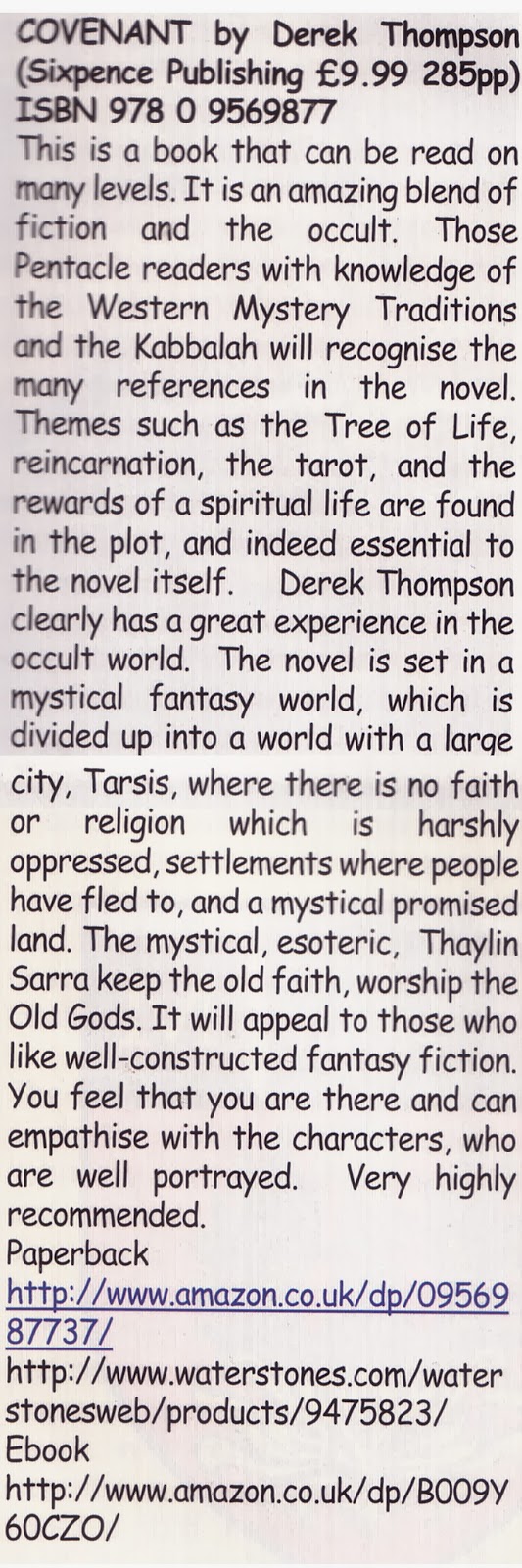
This review for my magical fantasy, Covenant, is from Pentacle - The UK's leading Independent Pagan Magazine. In many ways it marks a milestone for my book and for me.
How so?
Well, it's a review in a respected magazine - with readers who would likely enjoy Covenant. It's also a golden opportunity (there's that metal again) to promote not only those all-important sales links, but Covenant as a contribution to the Western Mysteries.
More importantly, it allows me to stop and reflect back on the work that went into Covenant - both the crafting of the story and the characters, over many years, and the design of the esoteric elements.
Sometimes, in the rush to get started on the next book, especially if the previous book has been slow to reach its audience, we can become dismissive of our achievements. I feel fortunate indeed to have received recognition from one of my peers. It feel like a nod from the Unseen for continuing with the book over its many adventures (deceased editor, 15 month wait for a response, publisher going under, etc).
The review pretty much says everything that I would want to say about Covenant. Whatever else happens with the book, I can feel confident that my aim was true. (At least until someone hates it!)
In fairness, there are practical benefits to a review like this as well:
1. My local branch of Waterstones promised to get in some copies, so I can now contact them to make good on their word. I'll keep you posted on how that goes.
2. A couple of independent bookshops have offered to display copies of Covenant alongside the review.
3. I've already had emails and given away review copies. In fact, tell you what, to celebrate the mag review, I'll give a PDF review version to the first five people to email me on asabovesobelow(at)btinternet.com, using the title: Covenant blog review.
4. I can add this review to my social media broadcasts.
Now, what was I saying about that next novel...
One year on
It's a little over a year now since I took the plunge and self-published Covenant, my fantasy, in ebook and paperback. I was always upfront with others and myself that it was never just about the money. That didn't even register on my top five list:
1. Get Covenant out there.
2. Get reviews.
3. See whether readers got the essence of Covenant, given its mystical and magical heart.
4. Learn about marketing (another form of mysticism and magic, as far as I was concerned), and what works for a book like mine.
5. Go into a bookshop and see Covenant on the shelf.
Okay then, maybe sales / money was hovering around six or seven.
So how did I get on and what have I learned?
1. Covenant is out there and I'm very proud of it. Both the ebook and the paperback versions benefited enormously from my having supportive friends with technical expertise of, on the one hand, formatting ebooks and negotiating the labyrinthine (to me) process of setting everything up on Lightning Source, and, on the other, turning a word doc into an actual book file. I also discovered that one more proofread is worth its way in gold (let me know how you do that). It's all fixed now, but early purchasers may find those few typos make it a collector's item in the years to come!
2. I have a clutch of reviews by people who clearly appreciate what Covenant is about. I mean the deeper stuff - the story behind the story. I can always use more though - just in case anyone is still holding back.
3. Some readers loved Covenant and wanted to discuss it with me. That was fun. Others found it too long and wordy (as opposed to numbery, which only applied to the top right of the page header). Them's the breaks, as they say.
4. What I learned about marketing and sales may be specific to me, but I'm the caring, sharing type:
a) Chain and independent bookshops are not that interested in self-published novels. You can chat for a few minutes, leave a paperback and an ebook on a disc, shake on it and still never hear from them again. They have a business to run and if you can't demonstrate the profitability of your book - or you get your timing wrong - you'd best chalk it up to experience.
b) Giveaways on Kindle help spread the word, but don't hound your Twitter followers with endless (if occasionally witty or ingenious) messages about your opus. Also, freebies do not automatically lead to reviews of any persuasion. I gave away about 300 copies and received a single review - but thanks anyway.
5. I regret to report that I'm still waiting to see Covenant on a shelf in a bookshop. I could sneak one in for effect and have someone take a photo of a delighted me, but that would just be cheating.
So is that the end of the story then?
Not at all.
I know that Covenant will be a grower and I know that because my portfolio of books is growing. When I read about someone recently who'd written 20 books, I was envious of their productivity. And then I counted up my own books - published and unpublished, novels and others - and it totalled 13. Lucky for some.
So, although at the moment Covenant is my only full-length novel in print and digitised, it won't be the last. And of course, at some point, there'll be the sequel.
I also know that tribe is really important and I struggled to find the ideal readership for Covenant. I didn't want fantasy readers to try it and find it too esoteric or occult, and I worried that readers of occult books would find it too lightweight to be considered a credible work on the subject.
To some extent I still have that argument in my head. I mean, is Covenant a mystical fantasy, an epic quest, a set of pathworkings, a spiritual allegory, or a book about magic?
The truth is that it's all of those things, and more. You see, that's the thing about a book - it's not just the characters that have lives of their own! It's true of any form of artwork: it is what it is. If you like it, that's genuinely brilliant for the creator. And if you don't, it's a bummer all round, so you'd best move on and find something else more to your liking.
However, if you do enjoy fantasy quests interspersed with ideas about reincarnation, the tarot, pathworkings, mythology, archetypes, magic, mysticism, allegory, the Western Mystery Tradition and the occult, Covenant could be just the thing. That also applies if you have a space in your bookshop!
You can purchase Covenant by clicking on the link: viewBook.at/Covenant